Industrial 3D Printers
Industrial 3D printers are advanced additive manufacturing systems that support engineering workflows from prototyping to functional end-use parts, low-volume production, silicone 3D printing, and multi-material manufacturing. The LayersTech M1 PRO merges these capabilities into a single, production-ready system.
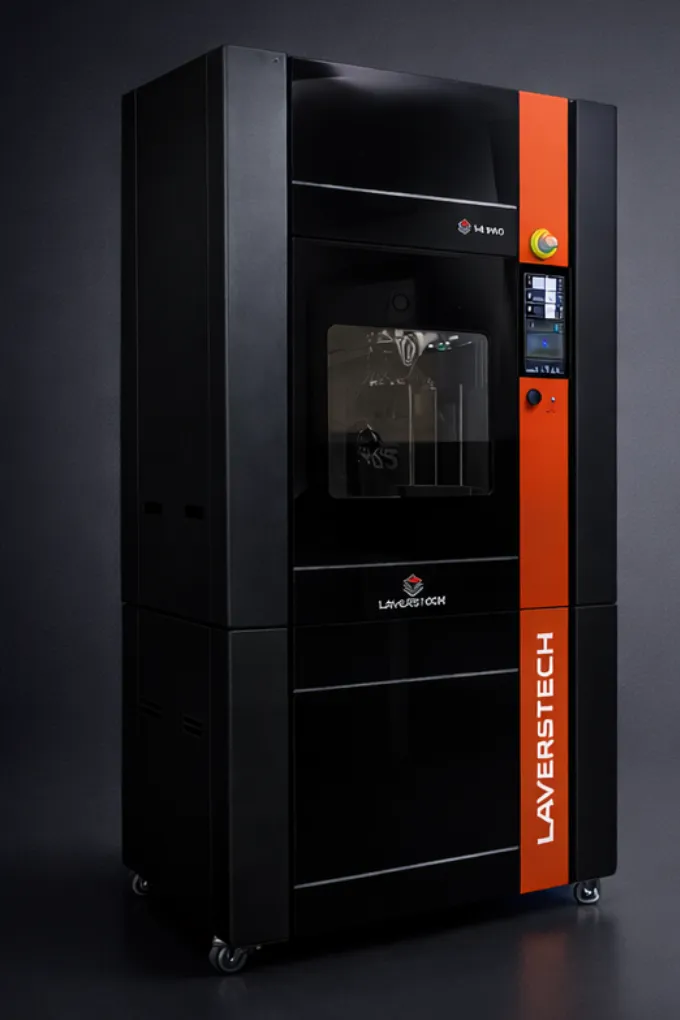
Production-ready
Repeatable manufacturing quality, going far beyond basic prototyping
Thermal control
Enclosed cabinet with active temperature management for stable prints
Multi-material
FFF polymers, soluble support materials, elastomers, and silicone
Enterprise Support
Professional service, system security, and manufacturing uptime
What is an Industrial 3D Printer?
An industrial 3D printer is an additive manufacturing system built for consistency, reliability, and precision in engineering and manufacturing environments. In these systems, characteristics like mechanical stiffness, enclosed thermal management, software security, and modular toolheads are critical to ensuring continuous production uptime.
While desktop 3D printers excel at simple visual concept models, industrial systems bring digital designs directly into end-use production. They are commonly used for creating production-ready fixtures, functional test components, high-temperature polymer components, and flexible silicone structures.
Selection Criteria
- Build volume, rigid frame structure, and mechanical stability
- Enclosed build chamber and controlled environment
- Compatibility with high-temperature engineering materials
- Multi-material printing capabilities and toolhead choices
- Suitability for processing silicone, LSR, and flexible elastomers
- Professional training, spare parts, and production-grade support
Desktop 3D Printers vs. Industrial 3D Printers
Standard 3D Printers
- Suitable for basic prototyping and visual models
- Limited material choices and temperature capacities
- Requires frequent operator intervention on long runs
Industrial 3D Printers
- Aims for repeatable, reliable, and production-grade output
- Features enclosed build chambers and robust motion platforms
- Supports advanced processes like multi-material and silicone printing
Multi-Material & Silicone Industrial Manufacturing
An industrial 3D printer should not be limited to rigid plastic filaments. Modern engineering teams require the flexibility to process different material groups, soluble supports, elastomeric components, and high-temperature polymers in a single unified manufacturing workflow.
The LayersTech M1 PRO stands out by integrating high-temperature FFF, multi-material capabilities, and real silicone 3D printing (LSR workflows) on a single platform. This versatile system allows teams to address diverse engineering challenges efficiently.
Controlled Process
Coordinated control of motion, thermal profiles, and material dosing
Multi-Toolhead
Flexible toolhead configurations for various manufacturing tasks
Repeatability
Robust mechanics and optimized firmware for consistent results
Silicone Advantage
Direct printing of flexible elastomers and LSR without molds
Where are Industrial 3D Printers Used?
Frequently Asked Questions
What is an industrial 3D printer?
An industrial 3D printer is a professional additive manufacturing system designed for repeatable part production. It features a rigid chassis, enclosed cabinet, controlled temperatures, advanced material compatibility, and production-ready software.
What is the difference between a desktop and an industrial 3D printer?
Desktop 3D printers are typically suited for basic concept modeling. Industrial 3D printers, however, meet rigorous professional demands by supporting long build times, high-temperature engineering polymers, multi-material setups, consistent quality reproduction, and dedicated enterprise support.
Which industries benefit most from industrial 3D printers?
Industrial 3D printers are widely utilized in automotive, robotics, medical, aerospace, defense, and manufacturing industries for creating tooling, custom fixtures, low-volume end-use parts, and flexible silicone components.
Can industrial 3D printers process real silicone?
Yes. With controlled material flow, stable motion, and integrated curing mechanisms, silicone 3D printing can be performed reliably on industrial platforms. The LayersTech M1 PRO combines this process with multi-material FFF printing in a single system.
Let's Plan Your Industrial 3D Printer Selection Together
Evaluate the most suitable tech configurations, material groups, or silicone 3D printing requirements for your engineering project with our specialists.