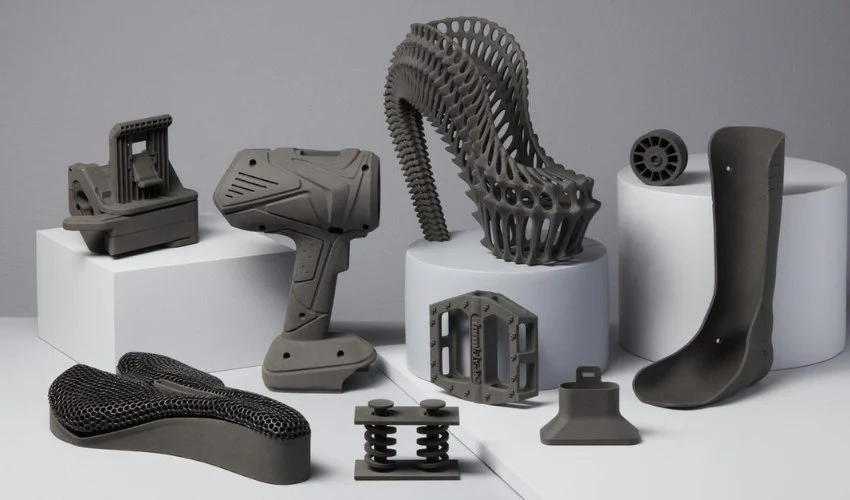
3D Prototype Modeling for industrial prototyping and design validation.LayersTech delivers industrial 3D prototyping solutions for manufacturing teams that need fast iteration, reliable validation, and production-ready results. Our systems support complex use-cases across plastics and metals—helping you reduce development risk and accelerate time-to-market.
We help companies in aerospace, tooling, industrial manufacturing, lifestyle, and automotive maximize the value of additive manufacturing with repeatable workflows and engineering-focused process control.
Explore our industrial 3D printers or learn more about our
FFF/FDM systems and
silicone (LSR) and multi-material platforms.
Industrial 3D Prototype Modeling with Additive Manufacturing
3D prototype modeling enables a seamless transition from design to physical validation. Because parts are produced directly from digital 3D models, engineering teams can test multiple iterations quickly, optimize designs based on real results, and move forward with confidence.
What you can validate with 3D printed prototypes
Form & fit checks for assemblies and interfaces
Functional performance using real material properties
Process feasibility for complex geometries without tooling
Iteration speed with fast design updates and minimal added cost
Unlike traditional manufacturing, geometric complexity does not automatically increase cost or lead time in 3D printing—making it ideal for advanced prototyping and low-volume validation.
Cost-Effective Industrial Prototyping
Additive manufacturing reduces prototyping costs in both single-part and small-batch production. Traditional methods like milling, turning, or casting often require dedicated tooling and setup steps that get more expensive as designs become more complex.
Key benefits
No tooling required — ideal for one-offs and low-volume runs
Cost is driven by geometry, not complexity (no molds or special fixtures)
Lightweight, strong structures that reduce material usage
Shorter development cycles with fewer setup constraints
Technologies for 3D Printed Prototypes (SLS & DMLS)
Depending on material and performance requirements, prototype production can use multiple industrial processes. Selective Laser Sintering (SLS) is commonly used for durable polymer prototypes, while Direct Metal Laser Sintering (DMLS) supports metal prototypes where strength and temperature performance are required.
If you want a quick reference, see:
Selective laser sintering and
Direct metal laser sintering.
Functional integration
Print assemblies as one unit (hinges, springs, moving features where suitable)
Reduce assembly steps by minimizing part count
Faster revisions without retooling or new fixtures
Industry Applications of 3D Prototyping
Aerospace & Space — lightweight, high-strength components
Tooling & Industrial — fixtures, jigs, and functional prototypes
Automotive — optimized prototypes for performance and packaging
Medical & Lifestyle — custom forms, ergonomic iterations, and design validation
Real-World Success: Injection Molding Case Study
A manufacturer used DMLS technology to optimize an injection molding process, achieving measurable improvements:
43% reduction in cooling time
31% faster cycle time
More stable production performance with improved efficiency
From Prototype to Production
3D prototype modeling bridges the gap between concept validation and full-scale production. By using industrial-grade systems and materials, teams can move from functional prototypes to end-use parts with fewer design changes—reducing risk, improving predictability, and shortening time-to-market.
Why Choose LayersTech for 3D Prototyping?
Faster iterations with industrial-grade reliability
Lower development cost through tool-less prototyping
Greater design freedom for complex geometries and optimized structures
Ready to discuss your application? Tell us your part size, material requirements, and target performance—our team will recommend the best workflow.